
Journal
What makes nanomaterial sustainable?
How does LADA connect the choice of material, local production and the way a garment is used? The article presents the brand's view of care, origin and life in the wardrobe.
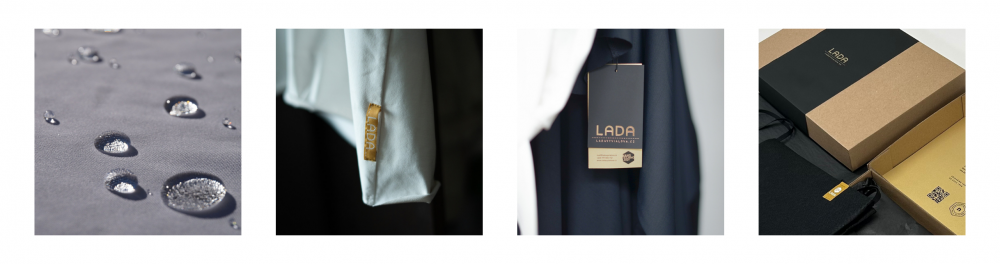
Can a technically engineered fabric be more sustainable than cotton? In our case, yes. In Lada Vyvialová's atelier we sew from a nano fabric that needs not a single drop of water or hazardous chemicals in its production. And thanks to a unique certified Czech technology, the silver nanoparticles are firmly anchored as the fibre is made, which prevents them from being released. As we apply no surface finish to the garments, the fabric releases no microplastics either. We have the fabric made in the Vysočina region and sew the finished pieces from it in northern Moravia.
Local production and local suppliers
The whole life cycle of our pieces therefore takes place within a radius of 300 km. From threads, press studs and elastics to hang tags and wrapping paper. Everything is made here or nearby. We work with local manufacturers and support small businesses. Not only for ecological reasons, but also so that we can oversee the production of every component and, where needed, consult it and adjust it with the makers to our satisfaction and yours. We know who makes the materials for our garments and under what working conditions.

And that cannot always be said of textiles made from natural materials. Since neither cotton nor silk is grown or produced in Central Europe, we cannot control where the raw materials for the fabrics are grown. Nor under what conditions the fabrics are woven.
Ecological and ethical production of the nano fabric
Every natural crop has a natural radius in which it grows. A natural consumption of air, light, water and food (in the case of the silkworm). And these are all aspects we cannot influence from Příbor. Control over production and an ethical working environment in countries with a tropical climate is not easily gained, and it would require a great deal of travel and diesel. That is why imported resources are questionable for us, and not only because of the need to import them and the carbon footprint that leaves.

Using linen, hemp or wool, on the other hand, does make sense to us. These are plants typical of Central Europe and we can grow them in our own field. Or shear the wool from a sheep living in our garden. Both the origin and the processing happen here.
Why nano, of all things?
Because the nano fabric gives us greater utility and properties that neither natural nor other materials offer:
- it wicks sweat away from the body,
- it dries quickly and keeps the skin dry,
- it regulates temperature thanks to the special profile of the fibre,
- it is antibacterial,
- it eliminates odour,
- it provides UV protection,
- it has a self-cleaning lotus effect, effective against droplets,
- it holds its shape – it does not shrink with repeated use,
- it is easy-care and needs no ironing,
- its functionality is unlimited,
- it offers an ecological solution that is sustainable and saves on laundry costs.

The benefits of the nanomaterial, local production and processing, and the degradability of the nanotechnology are, for us, the key arguments for making fashion from nanomaterials. What is more, the likelihood that people will wear our pieces for longer and get more use out of them is very important to us.
Kind to the planet and to your wallet
Even caring for and washing nanomaterials puts less strain on the planet than ordinary clothing. Thanks to its properties, you can wear nano clothing for much longer without needing to wash it, which reduces the consumption of water, electricity and detergent. As it needs no ironing, you save energy and time. You will find our recommendations on how best to care for nanomaterials in one of our articles.
Thanks to all these possibilities of Czech nanomaterials, we decided to create sustainable designer fashion in our own way. We do not know whether it is the best approach, but for us it makes the most sense. And perhaps it will for you too.
You can find out more about how our atelier works here.